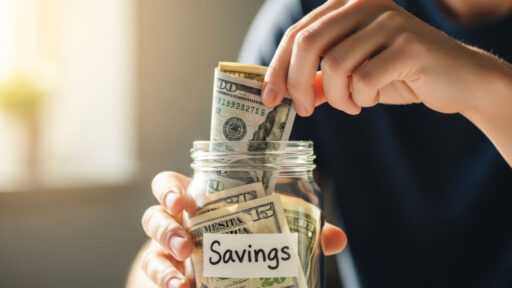



In February 2026, the median emergency savings balance for Americans is $500.
Not $5,000. Not $15,000. Five hundred dollars. That is the middle of the entire distribution—the number that exactly half of Americans are above and half are below, according to Empower research conducted June 2025.
Meanwhile, the standard advice is three to six months of expenses. For most American households, that means $12,000 to $24,000. The gap between where most people are and where advice tells them they should be is so large that 55% of Americans say the three-to-six-month rule feels unrealistic.
They are not wrong to feel that way. The rule is real and the target is genuinely worth reaching. But presenting it without context—without acknowledging where most people start, what the actual milestones are, and how to close the gap step by step—is why so many people read an article about emergency funds, feel overwhelmed, and close the tab without doing anything.
The difference between $500 and $2,000 is not cosmetic. Research shows financial stress drops significantly once households reach $2,000 in emergency savings—even though this is well below the full three-to-six-month target.
This guide does something different. It tells you exactly how much you need for your specific situation—not a one-size-fits-all number. It explains why the $500 median is so damaging. And it shows you the step-by-step path from wherever you are right now to a fully funded emergency fund, regardless of what that starting point looks like.
Table of Contents
How Much Emergency Fund Do You Really Need?
Most people need three to six months of essential expenses, not total income.
If your essential expenses are $3,000 per month, your emergency fund target is:
- $9,000 (3 months—stable income)
- $18,000 (6 months—variable or higher risk income)
The right number depends on income stability, dependents, and job security. The first milestone, however, is much smaller: $500 to $2,000, which dramatically reduces financial stress and prevents new debt.
For the complete framework on how emergency funds fit into your overall financial picture, see our complete guide to personal budgeting.
What an Emergency Fund Actually Is—and What It Is Not
An emergency fund is money set aside in a dedicated, accessible account specifically to cover genuine financial emergencies without going into debt. Not for holidays. Not for planned expenses. Not for a sale that felt like an emergency. For the unexpected events that arrive without warning and without permission—job loss, medical bills, car breakdown, urgent home repair.
An unexpected financial setback can detonate a monetary grenade on your carefully crafted monthly budget. Car repairs or medical bills can crop up at any time. A job loss can leave you without income you were counting on to pay your bills. An emergency fund can soften these blows.
The Three Defining Characteristics of a True Emergency Fund:
1. It is separate from your regular checking account. Money kept in the same account as daily spending will be spent on daily spending. The physical separation—even by one bank transfer—is what creates the psychological and practical barrier that preserves the fund for genuine emergencies.
2. It is accessible within one to two business days. An emergency fund is not an investment. It does not belong in the stock market, in a certificate of deposit with early withdrawal penalties, or in any account where accessing it takes more than 48 hours. Emergencies arrive on their own timeline, not yours.
3. It is reserved for genuine emergencies only. 27% of Americans admit to using their emergency savings for non-essentials. Nearly one-quarter of Americans surveyed (23%) tapped into their emergency fund for holiday purchases. An emergency fund used for non-emergencies is not an emergency fund—it is a savings account with a misleading label. Clarity about what constitutes a genuine emergency before the fund is needed is what prevents the rationalization that erodes it.
What Counts as a Genuine Emergency:
- Sudden job loss or significant income reduction
- Medical or dental bill not covered by insurance
- Car repair necessary for employment
- Emergency home repair (heating failure, plumbing emergency, roof damage)
- Unexpected travel for a family crisis
What Does Not Count, No Matter How It Feels in the Moment:
- Holiday shopping
- Planned travel
- A sale on something you wanted
- Non-urgent home improvements
- Any expense you could have anticipated with reasonable planning
Why the $500 Median Is So Financially Dangerous
The median emergency savings balance of $500 is not simply a number. It is a description of a specific financial vulnerability that compounds in highly predictable ways.
More than two in five Americans surveyed (43%) couldn’t pay for a $1,000 emergency expense with their savings. One-third say they don’t have enough savings to cover even one month of living expenses.
29% of Americans say they can’t afford an unexpected expense over $400.
When a genuine financial emergency arrives and no fund exists to absorb it, three things happen in sequence. First, the expense goes onto a credit card at 20–28% APR. Second, the minimum payment on that debt becomes a new fixed monthly expense that reduces the capacity to save. Third, the next emergency—which arrives before the first debt is fully paid—goes on the card as well. The cycle is self-reinforcing.
59% of Americans in 2025 don’t have enough savings to cover an unexpected $1,000 emergency expense. “We are essentially a paycheck-to-paycheck nation,” said Bankrate Senior Economic Analyst Mark Hamrick. “Fewer Americans have the financial safety net to cover inevitable unexpected expenses, despite low unemployment and steady growth.”
The specific dollar amount that changes this dynamic is smaller than most people assume. Vanguard’s research finds that having emergency savings—notably reaching at least $2,000—is strongly associated with higher financial well-being and lower financial stress. The transition from $0 to $2,000 produces more measurable improvement in financial stress than the transition from $2,000 to $10,000. The first milestone is the most important one.
Why Is the Recommendation 3–6 Months?
The three-to-six-month standard exists because it matches the realistic timeline for recovering from the most common major financial emergencies.
Average job search duration: The Department of Labor reports that the average job search for professionals ranges from 10 weeks to 6 months, depending on income level, specialization, and industry conditions.
Income disruption timeline: Most serious financial emergencies—job loss, medical recovery, family crisis—resolve or stabilize within this window. Three months covers short-to-medium disruptions. Six months covers extended ones.
Recovery window: Beyond six months, you’re typically dealing with life changes that require structural adjustments beyond emergency savings alone—career transition, relocation, business changes.
Cushion vs crisis: Below three months, you have a buffer that absorbs shocks but doesn’t prevent crisis if the emergency extends. Above six months, additional savings produce diminishing stress reduction—the psychological benefit plateaus.
The 3–6 month range is not arbitrary. It’s based on decades of data about how long serious financial disruptions typically last and how much savings is required to weather them without accumulating debt.
How Much Emergency Fund Should I Have Based on Income?
Your emergency fund target is not based on your income—it’s based on your essential monthly expenses. This is a critical distinction that many people misunderstand.
A person earning $80,000 annually with $2,500 in monthly essential expenses needs the same emergency fund as a person earning $50,000 with $2,500 in essential expenses: $7,500–$15,000.
Why Essential Expenses, Not Income?
Your emergency fund exists to replace lost income and cover unexpected costs during a financial crisis. What matters is how much you actually need to survive each month—not how much you normally earn.
Essential expenses include only:
- Housing (rent/mortgage)
- Utilities
- Groceries
- Transportation
- Insurance
- Minimum debt payments
- Childcare (if applicable)
Not included: Dining out, entertainment, subscriptions, clothing, travel, hobbies—these can pause during a genuine financial emergency.
How Much Emergency Fund You Actually Need—Your Real Number
The standard advice—three to six months of expenses—is a starting point, not a final answer. The right amount for your specific situation depends on five factors. Work through each one honestly.
Factor 1—Your Monthly Essential Expenses
The foundation of your emergency fund calculation is your monthly essential expenses—not your total spending, not your income. Essential expenses only: housing, utilities, groceries, transport, insurance, minimum debt payments, childcare if applicable.
To figure out how much to put away, add the total amount you spend each month on food, housing, gas and other bills. So if your monthly bills amount to $2,000 a month, you’ll need $6,000 in savings to stay afloat in case of an emergency such as a job loss.
Use this calculation:
| Essential Expense Category | Your Monthly Amount |
|---|---|
| Rent or mortgage | $ |
| Utilities (electric, gas, water, internet) | $ |
| Groceries | $ |
| Transport (fuel, car payment, insurance) | $ |
| Health insurance | $ |
| Minimum debt payments | $ |
| Childcare or school fees | $ |
| Phone | $ |
| Total Monthly Essential Expenses | $ |
Multiply your total by three for a three-month fund target. Multiply by six for a six-month target. These are your two goalposts.
Quick Emergency Fund Calculator
Step 1: Add up your essential monthly expenses
Step 2: Multiply by 3 (minimum target)
Step 3: Multiply by 6 (ideal target)
Example:
$2,500 essential expenses × 3 = $7,500
$2,500 × 6 = $15,000
Your target range: $7,500–$15,000
Factor 2—Your Income Stability
The three-to-six-month range exists because different income situations carry different risk profiles.
Closer to three months if:
- You have stable, salaried employment with a long track record
- Your industry has strong employment demand and low layoff risk
- Your household has dual incomes—if one is lost, the other continues
Closer to six months if:
- You are a freelancer, contractor, or self-employed
- Your income is commission-based or variable month to month
- You work in an industry with historically higher layoff rates
- You are a single-income household with dependents
Beyond six months if:
- You own a business with volatile revenue
- Your professional skills are highly specialized with a long job search horizon
- You have significant health conditions that increase the probability of medical emergencies
Factor 3—Your Dependents
Every person who depends on your income for their essential needs increases the appropriate target for your emergency fund. A single person with no dependents recovers from income loss with less time pressure than a household supporting children, elderly parents, or a partner who is not currently employed.
Factor 4—Your Job Market
How long would it realistically take you to find comparable employment in your field if you lost your job tomorrow? The Department of Labor’s average job search duration for professionals ranges from 10 weeks to 6 months depending on income level, specialization, and industry. Your emergency fund needs to cover the realistic version of this timeline, not the optimistic one.
Factor 5—Inflation’s Impact on Your Target
A household that needed $9,000 to cover three months of expenses in 2020 may need closer to $11,500 in 2026. Even if their savings balance stayed the same, rising costs would shrink its real value as a financial cushion. Review your emergency fund target annually. A fund built several years ago at 2020 expense levels may no longer cover the same number of months it was designed for.
Is 3 Months Enough or Should I Save 6?
Three months is enough if:
- You have stable employment with low layoff risk
- Your household has dual incomes
- You work in a field with strong job market demand
- You have no dependents or significant health concerns
Six months is better if:
- You’re self-employed or have variable income
- You’re a single-income household with dependents
- Your field has longer average job search timelines
- You prefer maximum financial security and lower stress
The honest answer: Three months is the minimum that qualifies as a genuine safety net. Six months is the ideal that provides full resilience against realistic worst-case scenarios. Start by building to three months, then evaluate whether the additional security of six months is worth the extra time and effort based on your specific situation.
Your Personalized Emergency Fund Range
| Situation | Recommended Target |
|---|---|
| Stable salary, dual income, no dependents | 3 months of essential expenses |
| Stable salary, single income, no dependents | 3–4 months |
| Variable income, no dependents | 4–6 months |
| Stable salary, single income, with dependents | 4–6 months |
| Self-employed or freelance, with dependents | 6–9 months |
| Business owner with variable revenue | 6–12 months |
| Single parent, sole income earner | 6 months minimum |
Is $1,000 Enough for an Emergency Fund?
$1,000 is a good starting milestone but not complete protection.
What $1,000 covers:
- Most common car repairs ($200–$800)
- Typical medical copays and deductibles ($100–$500)
- Minor home repairs ($150–$600)
- Short-term income gaps (partial coverage)
What $1,000 does NOT cover:
- Job loss lasting weeks or months
- Major medical expenses
- Major car or home repairs
- Extended family emergencies
The verdict: $1,000 is Stage 1 in emergency fund building—a critical first milestone that prevents most small-to-medium emergencies from becoming debt. But it’s not the finish line. Your target remains 3–6 months of essential expenses.
The Four-Stage Emergency Fund Building Plan
The gap between $500 and a fully funded emergency fund is real. The path to closing it is not one large leap—it is four achievable milestones that each build on the last.
The Emergency Fund Ladder
Stage 1 → $500
Stage 2 → 1 Month
Stage 3 → 3 Months
Stage 4 → 6 Months
Each stage reduces stress and increases resilience.
Stage 1—The $500 Buffer (Week 1 to Month 2)
Target: $500 in a separate savings account.
Purpose: Absorbing the most common category of financial emergency—a car repair, a medical copay, a household item failure—without creating debt.
This stage is achievable even on a tight budget. For someone saving $60 per month, Stage 1 is complete in nine months. For someone who can find $100 per week in reduced spending, Stage 1 is complete in five weeks.
The $500 level is meaningful not because it covers major emergencies but because it breaks the debt cycle at the bottom end. The most frequent financial emergencies most people face—the ones that currently go on credit cards and sit there for months—are in the $200–$600 range. A $500 buffer absorbs most of them.
Proven ways to save money faster and build your emergency fund quickly.
For strategies when money is extremely tight: How to Save Money on a Tight Budget—19 Real Ways
Stage 2—One Month of Essential Expenses (Month 2 to Month 8)
Target: One full month of essential expenses (your figure from the table above).
Purpose: Covering short disruptions—a temporary job gap, an unexpected absence from work, a larger medical bill—without depleting reserves entirely.
One-third of Americans say they don’t have enough savings to cover even one month of living expenses. Reaching Stage 2 moves you into the financial position that one in three Americans has not yet reached. It is also the level at which emergency savings begin to measurably reduce financial stress.
The specific monthly contribution that gets you from $500 to one month fastest is automation. Set a transfer on payday—before the money has touched your checking account—to the dedicated emergency fund account. Even $100 per month builds one month of a $3,000 expense baseline in 25 months. Even $200 per month does it in under a year.
Stage 3—Three Months of Essential Expenses (Month 8 to Year 2)
Target: Three months of essential expenses.
Purpose: Covering serious disruptions—job loss, extended medical recovery, significant family emergency—without resorting to high-interest debt.
30% of Americans have some emergency savings, but not enough to cover three months’ expenses. Three months is the minimum level most financial planners consider a genuine financial safety net. At this level, a job loss produces stress but not crisis. Medical expenses produce disruption but not catastrophe.
Most people find that reaching Stage 3 is the point where their relationship with money changes qualitatively. The anxiety that accompanies a budget built with no margin disappears at this level—replaced by a different orientation toward financial decisions.
Stage 4—Six Months of Essential Expenses (Year 2 to Year 3–4)
Target: Six months of essential expenses.
Purpose: Full financial resilience across any realistic single emergency scenario—extended job search, serious health event, major home or vehicle expense, family crisis.
27% of Americans have enough to cover six months of expenses. Reaching Stage 4 places you in the top quarter of Americans by emergency preparedness. It does not mean financial invulnerability—it means financial resilience. The difference is meaningful.
At six months, emergency fund contributions can redirect toward other financial goals: retirement investment, debt acceleration, house deposit savings. The emergency fund does not keep growing indefinitely—once the target is reached, contributions shift to the next priority.
Where to Keep Your Emergency Fund—The Right Account Matters
The right account for an emergency fund has three non-negotiable characteristics: it is safe (FDIC or NCUA insured), it is liquid (accessible within one to two business days), and it earns the best available interest rate consistent with the first two conditions.
As of January 2026, many online high-yield savings accounts are offering roughly 4.5% to 5.0% APY—far above the FDIC’s national average savings rate of about 0.39%.
On a $5,000 emergency fund, the difference between 0.39% APY and 4.75% APY is $218 per year. On a $12,000 fund—three months of expenses for a median household—it is $522 per year. This money requires zero additional behavior. It is the return on keeping your emergency fund in the right type of account rather than the wrong one.
| Account Type | Typical APY | Accessible | FDIC Insured | Right for Emergency Fund |
|---|---|---|---|---|
| Traditional bank savings | 0.40–0.60% | ✅ Yes | ✅ Yes | ⚠️ Acceptable—low return |
| High-yield savings (online bank) | 4.50–5.00% | ✅ Yes (1–2 days) | ✅ Yes | ✅ Best choice |
| Money market account | 4.00–4.75% | ✅ Yes | ✅ Yes | ✅ Good choice |
| Checking account | 0.00–0.10% | ✅ Instant | ✅ Yes | ❌ No—too easy to spend |
| Stocks / investments | Variable | ⚠️ 3+ days, value fluctuates | ❌ No | ❌ No—risk of loss |
| Certificate of deposit (CD) | 4.00–5.00% | ❌ Penalties for early access | ✅ Yes | ❌ No—not liquid |
| Cash at home | 0% | ✅ Instant | ❌ No | ❌ No—not safe |
The one account that most people currently use for emergency savings—a traditional bank savings account at 0.40%—is the second-worst option on this list after keeping cash at home. Moving your existing emergency savings to a high-yield savings account is the single highest-return, zero-effort financial action available to anyone with an emergency fund already started.
One practical note on account separation: 56% of Americans keep their emergency savings fund and their savings account separate. The 44% who do not separate their savings may be at greater risk of depleting their reserves for non-essential expenses. A dedicated emergency fund account—ideally at a different institution from your daily banking, with no debit card attached—creates the friction that preserves the fund for genuine emergencies.
5 Emergency Fund Mistakes That Keep People Stuck
Mistake 1—Keeping It in Checking
Money in your checking account will be spent. The lack of separation between daily spending and emergency savings is the #1 reason emergency funds never materialize. Open a separate high-yield savings account today.
Mistake 2—Investing It in Stocks
The stock market can drop 20–30% during economic downturns—exactly when you’re most likely to need emergency funds. A $10,000 emergency fund invested during a market correction becomes $7,000 when you need to access it. Keep emergency funds in FDIC-insured savings accounts, not investments.
Mistake 3—Using It for Holidays
27% of Americans admit to using emergency savings for non-essentials. Nearly one-quarter tapped their emergency fund for holiday purchases. If you use your emergency fund for holidays, sales, or planned expenses, it’s not an emergency fund—it’s a savings account with a misleading name.
Mistake 4—Waiting to Start Until You Can Save “Enough”
Waiting until you can save $300/month means you start never. Starting with $25/month means you start now. The habit matters more than the amount in the first 90 days. Build the system first, increase the amount later.
Mistake 5—Not Adjusting for Inflation
A fund built in 2020 to cover three months may only cover 2.5 months in 2026. Review your emergency fund target annually and adjust for rising costs in housing, utilities, groceries, and insurance.
How to Build Your Emergency Fund Faster—Eight Specific Actions
Action 1—Automate Before You Can Spend It
Set up recurring transfers from checking to savings, or split your direct deposit so a fixed amount is saved automatically each pay period. Automation removes the monthly decision and the willpower requirement. The money moves before you have the option to spend it.
The specific mechanics: Log into your payroll system or bank account. Set up a recurring transfer of your chosen amount to your emergency fund account. The transfer date should be the day after payday or the same day. Once set, do not touch it unless a genuine emergency occurs.
Action 2—Start With Any Amount—Then Increase It Once
Saving even a small amount of money, such as $25 a week, is a good place to start during economic hardship. The most common mistake in starting an emergency fund is choosing an amount that feels meaningful and maintaining it rather than starting with anything that is sustainable and increasing it once. Set your first transfer at whatever you can genuinely maintain without creating a shortfall. Then set a calendar reminder for three months later to increase it by $25–$50.
Action 3—Direct Any Windfall Straight to the Fund
Tax refunds, overtime payments, birthday money, unexpected reimbursements, freelance payments above your usual income—direct these to the emergency fund before they reach your checking account. The money was never in your monthly budget. It will not be missed if it goes directly to the fund rather than disappearing into general spending.
The average US tax refund runs approximately $3,100 per year. For someone at Stage 1, a single tax refund gets them to Stage 2 in one transaction.
Action 4—Sell Unused Items—One Weekend Exercise
A weekend of selling unused items—electronics, clothing, sports equipment, furniture—typically generates $300–$800 for most households with reasonable accumulation of unused possessions. This is not a long-term strategy. It is a one-time injection of capital that accelerates an early stage milestone from months away to weeks away.
The psychological impact of reaching a milestone faster is not trivial. Early momentum in savings behavior is one of the strongest predictors of sustained savings habits.
Action 5—Find One Expense to Reduce and Redirect
Review your last three months of statements and identify one specific spending category that is running above its actual value to you. Not every category—one. Reduce it by a specific amount and add that exact amount to your automated emergency fund transfer.
The category most commonly identified in this exercise: food delivery. The typical reduction for someone who reduces food delivery from four nights per week to one: $120–$180 per month. Redirected to an emergency fund: $1,440–$2,160 per year.
Action 6—Use a Separate Online Bank With No Debit Card
The account design itself can prevent emergency fund erosion. An online high-yield savings account at a bank with no physical branch and no debit card attached introduces a 1–2 business day transfer delay and no impulse-withdrawal mechanism. Use accounts that are safe, insured, and separate from daily spending to reduce temptation.
Action 7—Name the Account Something Specific
Most banks and credit unions allow you to name savings accounts. “Emergency Fund—3 Month Goal” is more motivating than “Savings Account 2.” Named savings accounts with visible balances and visible targets have higher completion rates than unnamed ones—a well-documented finding in behavioral finance on savings goal-setting.
Action 8—Build the Emergency Fund Into Your Monthly Budget
An online savings account, money market account, money market mutual fund or a separate savings account with your existing bank or credit union can allow you to save emergency funds for the future. Make a budget—and stick to it. Establishing guardrails around your spending habits by putting a budget in place that allows you to start saving or stash more money away.
Every budget should have an emergency fund line item that is funded first—before wants, before discretionary spending. The emergency fund contribution is not an afterthought. It is a non-negotiable category given the same status as rent and groceries.
Step-by-step guide to building your first monthly budget or download a ready-to-use template from free budget spreadsheet templates.
Emergency Fund by Life Stage—How the Target Evolves
Your emergency fund target is not set once and maintained forever. It changes as your life changes—and reviewing it annually ensures it continues to reflect your actual situation.
In Your 20s—Foundation Phase
The primary challenge is building any buffer at all while managing student debt, entry-level income, and high cost-of-living environments in career-relevant cities. The realistic first target is $1,000–$2,000. Perfect is the enemy of started. A $500 fund in a high-yield savings account earning 4.75% APY is infinitely better than a $6,000 fund that exists only in next month’s plans.
Median emergency savings for Gen Z: $400. The priority is building the habit before building the balance. Automate $50 per month and focus simultaneously on income growth—the fastest path to emergency fund milestone completion on an entry-level salary.
In Your 30s—Building Phase
Career establishment, potential homeownership, children, and partnership create both higher essential expenses (raising the target amount) and potentially higher income (raising the capacity to save). This is the decade where reaching Stage 3—three months of expenses—should be the primary savings goal ahead of aggressive investment.
Median emergency savings for Millennials: approximately $2,500–$3,500. The target for most 30-something households—three to four months of expenses—is typically $9,000–$18,000 depending on location and household size.
In Your 40s and 50s—Solidifying Phase
Peak earning years create the opportunity to reach Stage 4 and maintain it, while simultaneously directing surplus to retirement investment. A paid-off or significantly reduced car, lower childcare costs, and career peak income all work in favor of fund completion.
The specific risk to guard against at this stage: emergency fund erosion from using it for non-emergencies. Around three in five Americans have used their emergency savings fund to cover basic living expenses within the last year. If the fund is being regularly used for living expenses rather than true emergencies, it is a signal that the monthly budget needs structural revision rather than that the fund target needs to be lower.
Near or In Retirement—Preservation Phase
Near or in retirement, liquidity matters. Selling investments in a downturn can lock in losses, so keeping extra cash on hand is prudent. Retirement adds a specific consideration: you do not want to sell investments at a market low to cover an unexpected expense. A 12-month cash buffer—substantially above the standard working-age recommendation—protects retirement investments from forced sales during market downturns.
The Emergency Fund and Your Full Financial Plan
The emergency fund is not a luxury financial product for people who have already optimized everything else. It is the foundation beneath every other financial goal—the precondition that makes them achievable.
Without an Emergency Fund:
- Every unexpected expense goes on debt, raising the cost of living
- Every budget is one car repair away from failing
- Every savings goal is regularly raided to cover crises
- Investing is counterproductive—market returns cannot outpace 24% credit card APR
With an Emergency Fund:
- Unexpected expenses are absorbed without debt
- Monthly budget can hold its structure across disruptions
- Savings goals survive contact with reality
- Investing surplus produces compounding returns on a stable financial base
The sequence matters: emergency fund first, then everything else.
Once your emergency fund is complete, the next steps:
The full budgeting framework—understanding how the emergency fund fits into your complete financial picture. Read: The Complete Guide to Personal Budgeting
Zero-based budgeting—the method best suited to building your emergency fund aggressively and tracking progress. Step-by-step guide to zero-based budgeting for aggressive saving.
Saving money faster—specific tactics for finding more money to direct toward your fund. Proven ways to save money faster and build your emergency fund quickly.
Real People—What Building an Emergency Fund Actually Changed
Jerome, 38—Warehouse Supervisor, Baltimore
Jerome had no emergency fund for twelve years of his working life. Every unexpected expense went on a credit card. After the emergency passed, the minimum payment stayed—a permanent increase in his monthly fixed costs from each crisis. By 2023 he had four credit cards with a combined balance of $9,400, all accumulated through emergency charges he had never planned for.
He started an automatic $150 transfer on the first of every month to a new high-yield savings account. He redirected his tax refund the following April—$2,200—directly to the account. Eight months after starting: $3,500 saved. His first emergency at that balance—a $680 car repair—was absorbed from the account rather than added to debt. The credit card balance was not increased for the first time in four years.
“I had been trying to pay off the credit cards for three years without progress because every few months something would go on them. Having the fund meant the balance actually started going down instead of staying the same.”
Priya, 26—Junior Designer, London
Priya’s challenge was psychological as much as financial. She earned enough to save but kept finding reasons not to—the fund felt too small to matter, the target felt too far away. She read that reaching $2,000 is associated with measurably lower financial stress and decided that was her first milestone, not three months of expenses.
She automated £100 per month and put a single freelance payment of £450 directly in. She reached £2,000 in eleven months. One month later she had her first genuine emergency—a dental bill of £380. She paid it from the account, transferred £100 back in the following month, and rebuilt the buffer.
“The moment I paid that dental bill from my savings account instead of putting it on a card—that was the first time in my adult life that a financial emergency felt like an inconvenience rather than a catastrophe.”
Frequently Asked Questions
How much emergency fund should I have?
The standard guidance is three to six months of essential expenses—meaning housing, utilities, groceries, transport, insurance, and minimum debt payments, not total spending. Your specific target within that range depends on income stability, number of dependents, job market conditions in your field, and whether you are a single or dual-income household. Freelancers, self-employed individuals, and single-income households with dependents should aim for six months or above. The most important milestone is not the full target—it is starting. Vanguard research finds that reaching at least $2,000 is strongly associated with higher financial well-being and lower financial stress.
Is it okay to invest my emergency fund for better returns?
No. The emergency fund should not be in the stock market, cryptocurrency, or any investment with value fluctuation. The defining feature of an emergency fund is certainty of value and immediate accessibility. A market downturn can reduce a $10,000 invested emergency fund to $7,000 precisely when a financial emergency forces you to access it. Keep emergency funds in FDIC-insured high-yield savings accounts or money market accounts—currently earning 4.50–5.00% APY, which is a genuine return without any risk to principal.
What counts as a genuine emergency for using the fund?
A genuine emergency is an unexpected, unavoidable expense or income disruption: job loss, medical or dental bill not covered by insurance, car repair necessary for employment, emergency home repair, or urgent family situation. Holiday shopping, planned travel, a sale, and non-urgent home improvements are not emergencies—they are expenses that belong in a budget or a sinking fund. The test: would a financial counselor consider this an emergency? If the answer requires significant justification, it is probably not.
What if I cannot afford to save anything for an emergency fund right now?
Start with $10 per month. Not because $10 per month builds a meaningful fund quickly—it does not. But because the habit of automatic transfer toward a dedicated account is worth more in the long run than the specific dollar amount. The habit establishes the system. Income increases and expense reductions over time make increasing the transfer possible. Additionally, audit subscriptions and recurring charges—most people find $40–$130 per month in forgotten or unused charges that can be immediately redirected. Even $50 per month reaches the $500 Stage 1 milestone in 10 months. For tactics when money is extremely tight, see our guide on saving money on a tight budget.
Should I pay off debt or build an emergency fund first?
Do both simultaneously rather than sequentially. Build to $1,000 first—the minimum buffer that prevents most common emergencies from creating new debt. Then split additional capacity between debt repayment and continued emergency fund building. Building the emergency fund entirely first delays debt payoff and costs interest. Paying off all debt first before building the fund means every emergency adds new debt, often at higher rates than the debt you just paid off. The simultaneous approach is what most financial planners recommend for this reason.
Where is the best place to keep an emergency fund in 2026?
A high-yield savings account at an FDIC-insured online bank is the optimal choice for most people. As of January 2026, many online high-yield savings accounts are offering roughly 4.5% to 5.0% APY—far above the FDIC’s national average savings rate of about 0.39%. Choose an account with no monthly fees, no minimum balance requirement, and no debit card attached. The absence of a debit card makes impulsive access impossible, preserving the fund for genuine emergencies. Keep it at a different institution from your daily banking to further reduce the ease of access.
Is $500 enough for an emergency fund?
$500 is a critical first milestone but not a complete emergency fund. It covers most common small-to-medium emergencies ($200–$600 car repairs, medical copays, minor home repairs) without creating debt, which breaks the debt cycle at the bottom end. However, it does not cover job loss, major medical expenses, or extended emergencies. Your ultimate target remains 3–6 months of essential expenses ($9,000–$18,000 for most households), but $500 is where you start, not where you finish.
Should I pause investing to build an emergency fund?
Yes, temporarily. If you have no emergency fund or less than $2,000 saved, pause retirement contributions above your employer match and direct that money to emergency fund building until you reach Stage 2 (one month of expenses) or Stage 3 (three months). Once you have a basic safety net, resume investing. The reason: without an emergency fund, every unexpected expense goes on high-interest debt (20–28% APR), which erases investment returns (historically 7–10% annually) multiple times over.
Should my emergency fund cover total expenses or just essentials?
Just essentials. Your emergency fund target should be based on the minimum you need to survive each month—housing, utilities, groceries, transport, insurance, minimum debt payments, childcare—not your total typical spending. During a genuine emergency (job loss, medical crisis), discretionary spending (dining out, entertainment, subscriptions, hobbies) can pause temporarily. This makes your target more achievable: a household with $4,500 in total monthly spending might only need $3,000 in essentials, reducing the emergency fund target from $13,500–$27,000 to $9,000–$18,000.
Sources
All targets, milestones, and recommendations in this guide are sourced from the following verified sources:
- Bankrate Emergency Savings Report December 2025
- U.S. News 2026 Financial Wellness Survey January 2026
- Empower The Safety Net Emergency Savings Research June 2025
- Credible American Savings Statistics 2025
- Carry Average Emergency Fund by Age February 2026
- CBS News Americans Cannot Afford $1,000 Emergency January 2025
- Remitly US Emergency Savings Statistics April 2025
- Federal Reserve Board SHED Report 2024
- Vanguard Emergency Savings Research 2024
- Bureau of Economic Analysis Personal Saving Rate 2025
Ready to start? Begin with Stage 1—$500 in a separate high-yield savings account. Automate even $50/month and redirect one windfall (tax refund, bonus, sold items). For the complete framework that connects emergency fund building to your overall financial picture, see our complete guide to personal budgeting. For specific tactics to accelerate your savings, download our free budget spreadsheet templates.